

| Quick Answer: Most Dallas homes should be professionally washed once a year. Homes with heavy shade, mature oaks, stone facades, or recurring mildew often need cleaning every 6 to 9 months. The best time for your main wash is late spring, after peak pollen and early storm season. |
“How often should I do this?” We get that question a lot.
The answer depends on your house more than most Dallas homeowners expect. A two-story home on an open, sunny lot with Hardie board siding has a completely different cleaning timeline than a shaded limestone home tucked under live oaks in Lakewood or Preston Hollow.
Most homes in the Dallas area do well with one full professional house wash per year. But if your house sits under mature trees, has a shaded north-facing wall that stays damp, or shows green buildup on stone or stucco, you likely need service every six to nine months.
Most people search for “pressure washing,” even though the actual method used on most house siding is a gentler process called soft washing. The difference matters for both your home and your cleaning schedule.
The Short Answer: How Often Dallas Homes Need a Professional Wash
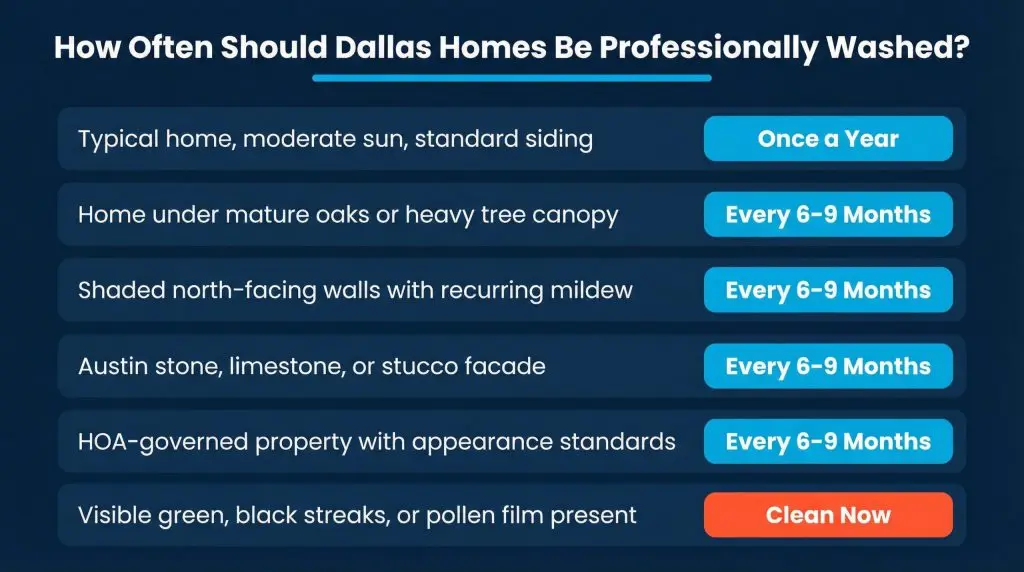
Annual cleaning works for most typical Dallas homes with moderate sun exposure, normal dirt accumulation, and no major mildew or pollen issues. That’s your baseline.
Every 6 to 9 months is better for homes under mature trees, homes with heavy spring pollen buildup, shaded north-facing elevations, Austin stone or stucco facades that visibly collect grime, and properties in HOA-governed neighborhoods where exterior appearance standards apply.
Clean now if you already see green patches, black streaking under the roofline, yellow pollen film on trim and soffits, or splash marks on lower brick and siding.
| Home Condition | Recommended Frequency |
| Typical home, moderate sun, standard siding | Once a year |
| Home under mature oaks or heavy tree canopy | Every 6–9 months |
| Shaded north-facing walls with recurring mildew | Every 6–9 months |
| Austin stone, limestone, or stucco facade | Every 6–9 months |
| HOA-governed property with appearance standards | Every 6–9 months (or as buildup appears) |
| Visible green, black streaks, or pollen film already present | Now |
That table covers most situations. But generic frequency advice only goes so far, because Dallas is not a generic city.
Why Generic “Once a Year” Advice Doesn’t Fit Dallas
Most national pressure washing blogs give the same answer: once a year, maybe twice if you live somewhere humid. That’s technically not wrong. But it skips everything that makes Dallas different.
Pollen, Pecans, and Organic Buildup
North Texas has three distinct pollen seasons, not one. Allergists at UT Southwestern have described the region as an especially challenging climate for allergy sufferers, with spring oak pollen, fall ragweed, and winter mountain cedar all contributing at different times of year. The residue is visible. Pollen collects on soffits, trim, window frames, porch ceilings, and entry areas, and it doesn’t rinse off on its own.
Our local tree canopy makes it worse. Live oaks and Shumard oaks are everywhere in Dallas neighborhoods. Add pecan trees and the tannin stains they leave behind on siding and concrete, and you’ve got organic buildup that a hose won’t remove.
Washing that residue off entry areas and window frames isn’t only cosmetic. It reduces the allergen load around the parts of your home you and your family walk through every day.
Spring Storms and the Splash-Back Effect
The National Weather Service identifies spring as the peak season for thunderstorms and severe weather in DFW, with spring and fall as the wettest periods of the year. For your home’s exterior, that means splash-back on lower siding and brick, streaking from dirty runoff, and moisture sitting in shaded areas long enough for mildew to take hold.
The timing of your wash matters as much as the frequency. Cleaning too early in spring means the worst pollen and storms haven’t hit yet. Cleaning too late means buildup has been baking in summer heat for months.
Dallas Homes Aren’t Built Like the National Average
Most competitor blogs write as if every house has vinyl siding. In Dallas, that’s rarely the case. We see Hardie board, metal, brick, wood, Austin stone, limestone, and stucco every single day. Very little vinyl.
That matters because these materials collect and show grime differently. A heavily soiled Austin stone facade can make even a smaller home look neglected faster than you’d expect. Cast stone is also common around here, and homeowners regularly ask us whether it can even be safely cleaned. It can, with the right method.
When to Schedule Your House Wash (Dallas Seasonal Guide)
Late Spring Is the Primary Wash Window
May is the sweet spot for most Dallas homeowners. By then, peak oak pollen has dropped, early spring storms have passed, and you’re ahead of summer entertaining, pool season, and the stretch of the year where curb appeal matters most.
Washing before May means you’re likely cleaning twice. Washing after June means months of buildup have already set into surfaces.
Fall Can Be the Right Second Cleaning Window
October and November work well for homes that need a second pass. If your house has shaded elevations, mildew-prone sides, or heavy tree cover that created a mess over summer, a fall wash resets things before cooler weather.
For most Dallas homes, spring is the must-do. Fall is the smart add-on for shade, trees, or recurring buildup.
| Season | Priority | Why |
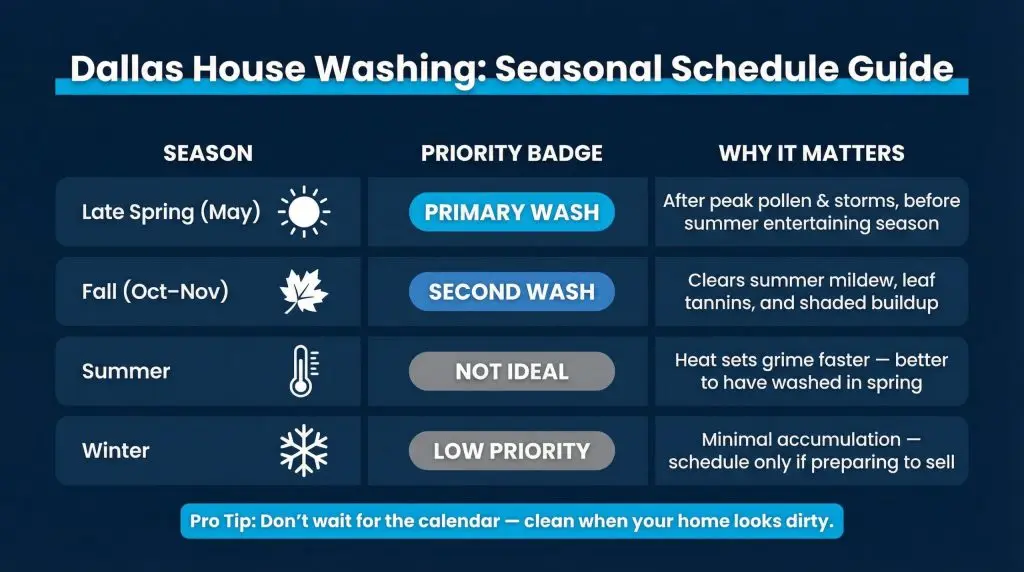
| Late Spring (May) | Primary wash window | After peak pollen and storms, before summer entertaining |
| Fall (Oct–Nov) | Second wash for qualifying homes | Clears summer mildew, leaf tannins, and shaded buildup |
| Summer | Not ideal for scheduling | Heat sets grime faster; better to have washed in spring |
| Winter | Low priority for most homes | Minimal accumulation; schedule only if preparing to sell |
Don’t wait for the calendar if your house already looks dirty. Frequency should be condition-based, not just calendar-based.
How to Tell Your House Needs Washing: 5 Signs You Can Spot from the Driveway
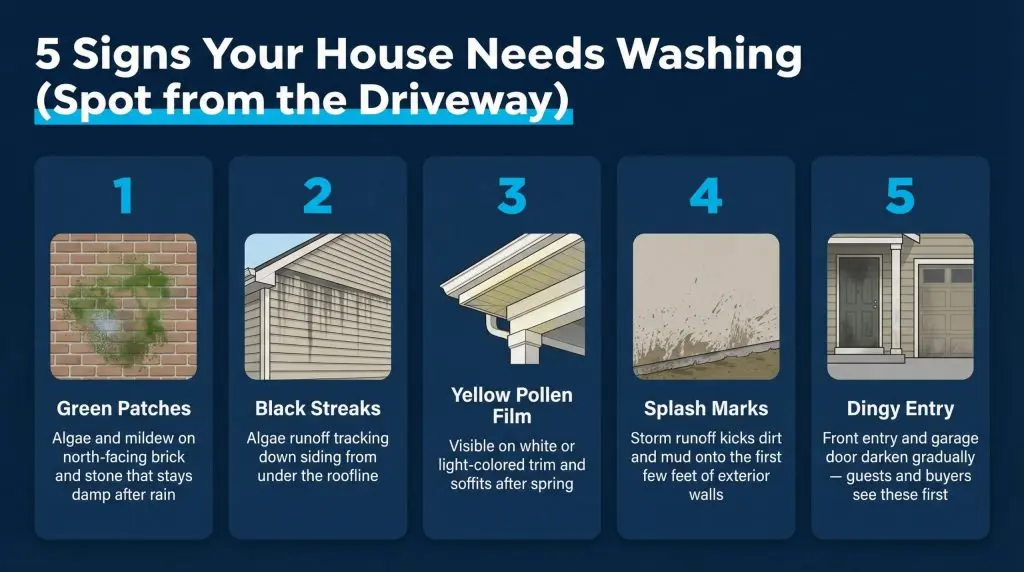
You don’t need to climb a ladder. Walk to the curb and look for these:
1. Green patches on shaded walls. Algae and mildew love north-facing brick and stone that stays damp after rain.
2. Black streaks under the roofline. That’s typically algae runoff tracking down your siding.
3. Yellow pollen film on trim and soffits. Especially visible on white or light-colored surfaces after spring.
4. Splash marks on lower brick or siding. Storm runoff kicks dirt and mud onto the first few feet of your exterior walls.
5. A dingy front entry or garage door. These are the surfaces guests and buyers see first, and they darken gradually enough that you stop noticing.
If only one wall or section looks bad, a targeted soft wash on that area can address the problem without cleaning the entire house. But if you’re seeing three or more of these signs, it’s time for a full wash.
Soft Washing vs. Pressure Washing: What Actually Happens to Your House
Why Most Dallas House Exteriors Are Soft Washed
Homeowners search “pressure washing,” but that’s not what we use on most house siding. Everything we do, we use what we call our three-step process: wash, treat, rinse. We go over the surface with a light wash of water, treat it with our soft wash solution, then rinse. Repeat if needed.
All of the common Dallas exterior surfaces are soft washed in one form or another. The chemical mix varies by material. An Austin stone house, for example, usually needs a stronger solution than brick or Hardie board. Certain types of painted exteriors require a different process entirely because some paint brands can’t tolerate sodium hypochlorite. We still clean those homes. We just adjust the approach.
That tracks with manufacturer guidance too. James Hardie’s care instructions for fiber cement siding recommend cleaning with a garden hose or low-pressure spray and caution against using a high-pressure washer on the surface.
| Surface | Method | Notes |
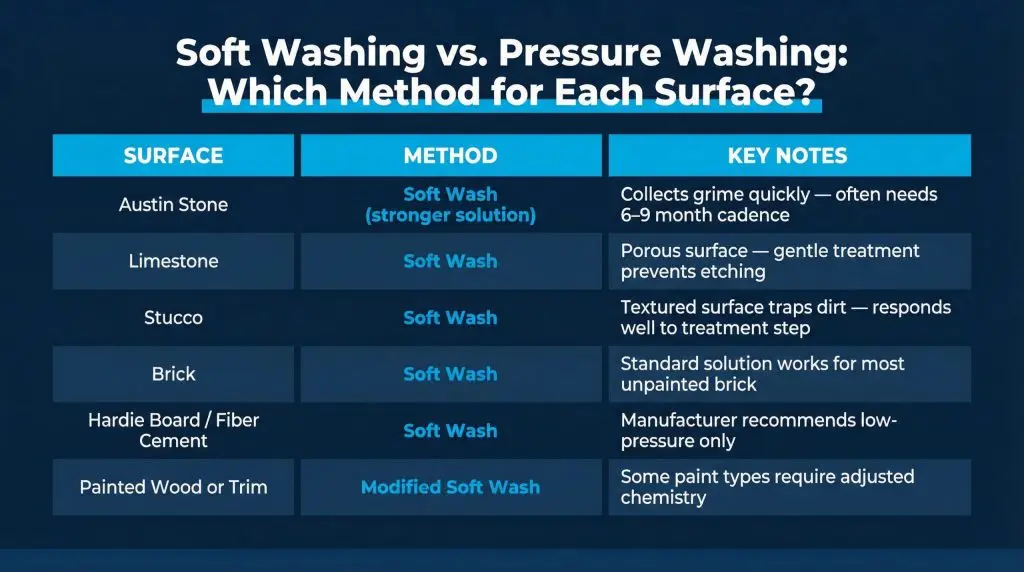
| Austin stone | Soft wash (stronger solution) | Collects grime quickly; often needs 6–9 month cadence |
| Limestone | Soft wash | Porous surface; gentle treatment prevents etching |
| Stucco | Soft wash | Textured surface traps dirt; responds well to treatment step |
| Brick | Soft wash | Standard solution works for most unpainted brick |
| Hardie board / fiber cement | Soft wash | Manufacturer recommends low-pressure only |
| Painted wood or trim | Modified soft wash | Some paint types require adjusted chemistry |
This same careful approach applies to roof cleaning, where walking on certain materials isn’t an option and everything is done touchless from the ground or side of the building.
What Changes the Right Washing Schedule for Your Specific Home
Trees, Shade, and Stone Facades
Homes under mature live oaks or Shumard oaks deal with more shade, more debris, and more pollen residue than open-lot homes. A shaded north-facing wall can develop visible mildew weeks after a rain while the sunny side stays clean. If your home has stone or stucco, those surfaces show grime faster than smooth siding.
These are the homes that benefit most from the 6-to-9-month cadence rather than strictly annual.
Size and Scope Tell a Different Story Than You’d Expect
A large house that’s mostly dusty or has a few cobwebs will be a quicker, simpler job than a smaller house with a heavily soiled stone facade. We price house washing by size, scope, and intensity of dirtiness, not just square footage. That same logic applies to how often you need to clean. The condition of your exterior matters more than the footprint.
Bundling Services Changes the Math
Pairing a house wash with window cleaning or driveway cleaning creates bundling discounts and makes regular maintenance more practical to schedule. If your Dallas-area HOA enforces exterior appearance standards, bundling keeps you in compliance without having to coordinate multiple service calls.
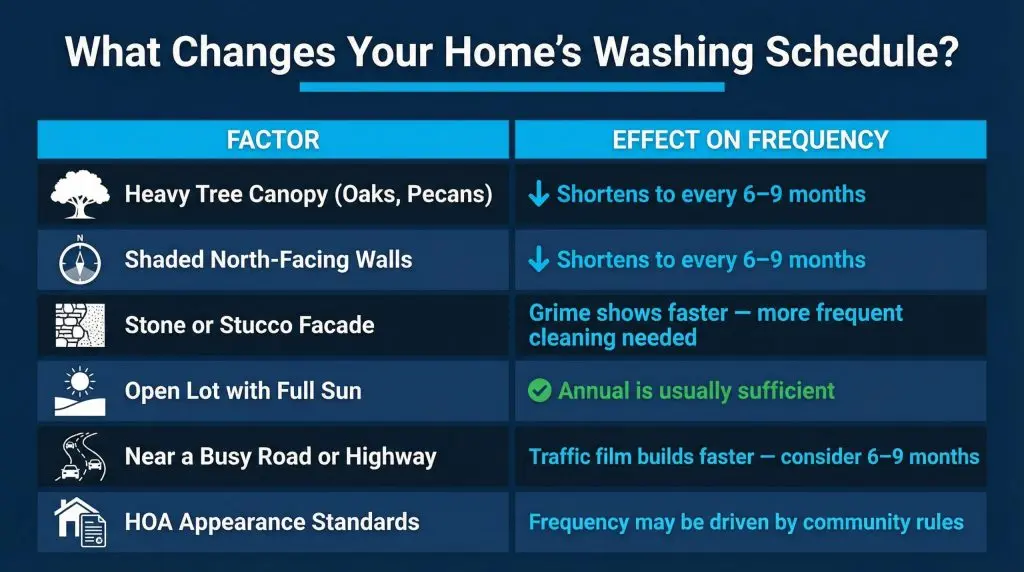
| Factor | Effect on Frequency |
| Heavy tree canopy (oaks, pecans) | Shortens to every 6–9 months |
| Shaded north-facing walls | Shortens to every 6–9 months |
| Stone or stucco facade | Grime shows faster; more frequent cleaning |
| Open lot with full sun | Annual is usually sufficient |
| Near a busy road or highway | Traffic film builds faster; consider 6–9 months |
| HOA appearance standards | Frequency may be driven by community rules |
Common Questions Dallas Homeowners Ask About House Washing
Is once a year enough?
For many homes, yes. Where we see homeowners run into trouble is waiting until the house looks bad, then calling for a one-time clean. That reactive approach usually means the buildup has had months to set in, which makes the job harder and often means it comes back faster. Homeowners who stay on a planned schedule, even if it’s just once a year, tend to get better results and spend less over time.
Can pressure washing damage my house?
Yes, and it happens more often than people realize. The most common damage we see on Dallas homes comes from someone using too much pressure on soft materials like painted wood, stucco, or aged mortar joints. That strips paint, gouges surfaces, or blows out caulking around windows. We soft wash specifically to avoid that. If a homeowner has had a bad experience with pressure washing before, the method was probably the problem, not the concept of cleaning the house.
What about leaky windows?
This is probably the most common concern we hear. Part of our prep communication with every customer covers this: make sure your windows are shut, put towels down under any windows you know leak, and if something does leak during the wash, let us know and we’ll come in and help dry it up. We’d rather you tell us about a tricky window upfront than discover it afterward.
How long does a typical house wash take?
A few hours to a full day or more, depending on size, dirtiness, and scope. We prefer to add team members to get the job done in one visit rather than come back the next day. Most homeowners prefer that too.
What other services should I combine with a house wash?
Window cleaning and driveway or concrete cleaning are the most natural pairings. Windows especially. You’ll notice the difference more when both the siding and the glass are clean at the same time. For a breakdown of what house washing typically costs in the Dallas area, we’ve put together a separate guide on how much a house wash costs in Dallas.
What’s the Right Washing Schedule for Your Dallas Home?
We offer free estimates and can often evaluate your home remotely using photos or satellite imagery for straightforward jobs. Park Cities Power Wash is veteran-owned, fully licensed and insured, and we back every job with a 100% satisfaction guarantee.
Not sure if your home needs annual service or something more frequent? Call us at (214) 390-3377 or email in**@*****************sh.com and we’ll recommend a schedule based on what your house actually needs.